One header to rule them all
Have you ever managed user permissions across 15 teams… with 15 different formats? This is a common problem in large organizations: you have multiple APIs handling authorization, and 15 client services calling them. The catch? Each team has implemented it their own way:
- The mobile team sends
X-Roles - The web portal team sends
User-Roles - The partners team sends
ROLES - Some don’t send anything at all
The result: Your backend has to deal with all of this. You either:
- Code 4 different ways to read the roles
- Ask 15 teams to change their code (spoiler: nobody will do it)
Before you start
If you already have a running Otoroshi instance, you can skip the following instructions.
Download the latest Otoroshi release:
curl -L -o otoroshi.jar 'https://github.com/MAIF/otoroshi/releases/download/v17.12.0-dev/otoroshi.jar'
Start Otoroshi with a custom admin password:
java -Dotoroshi.adminPassword=password -jar otoroshi.jar
Once started, access the Otoroshi admin UI at http://otoroshi.oto.tools:8080 using the credentials admin@otoroshi.io/password.
The Solution: Normalize Headers at the Gateway
With Otoroshi and its Expression Language, you can handle this at the gateway level by creating a single, unified header for each request that consolidates all possibilities.
Step 1: Create a route with header normalization
Create a new route using Otoroshi’s Admin API. This route will normalize incoming role headers into a single roles header:
curl -X POST http://otoroshi-api.oto.tools:8080/api/routes \
  -H "Content-type: application/json" \
  -u admin-api-apikey-id:admin-api-apikey-secret \
  -d @- <<'EOF'
{
  "id": "roles-api",
  "name": "roles-api",
  "frontend": {
    "domains": ["roles-api.oto.tools"]
  },
  "backend": {
    "targets": [
      {
        "hostname": "request.otoroshi.io",
        "port": 443,
        "tls": true
      }
    ]
  },
  "plugins": [,
    {
      "plugin": "cp:otoroshi.next.plugins.OverrideHost",
      "enabled": true
    },
    {
      "plugin": "cp:otoroshi.next.plugins.AdditionalHeadersIn",
      "enabled": true,
      "config": {
        "headers": {
            "roles": "${req.headers.x-roles || req.headers.user-roles || req.headers.roles :: anonymous}"
        }
      }
    }
  ]
}
EOF
The backend request.otoroshi.io is a mirror service that echoes back all headers and body it receives, perfect for testing.
Step 2: Test the normalization
Test with a custom header:
curl http://roles-api.oto.tools:8080 -H 'x-roles: admin,editor'
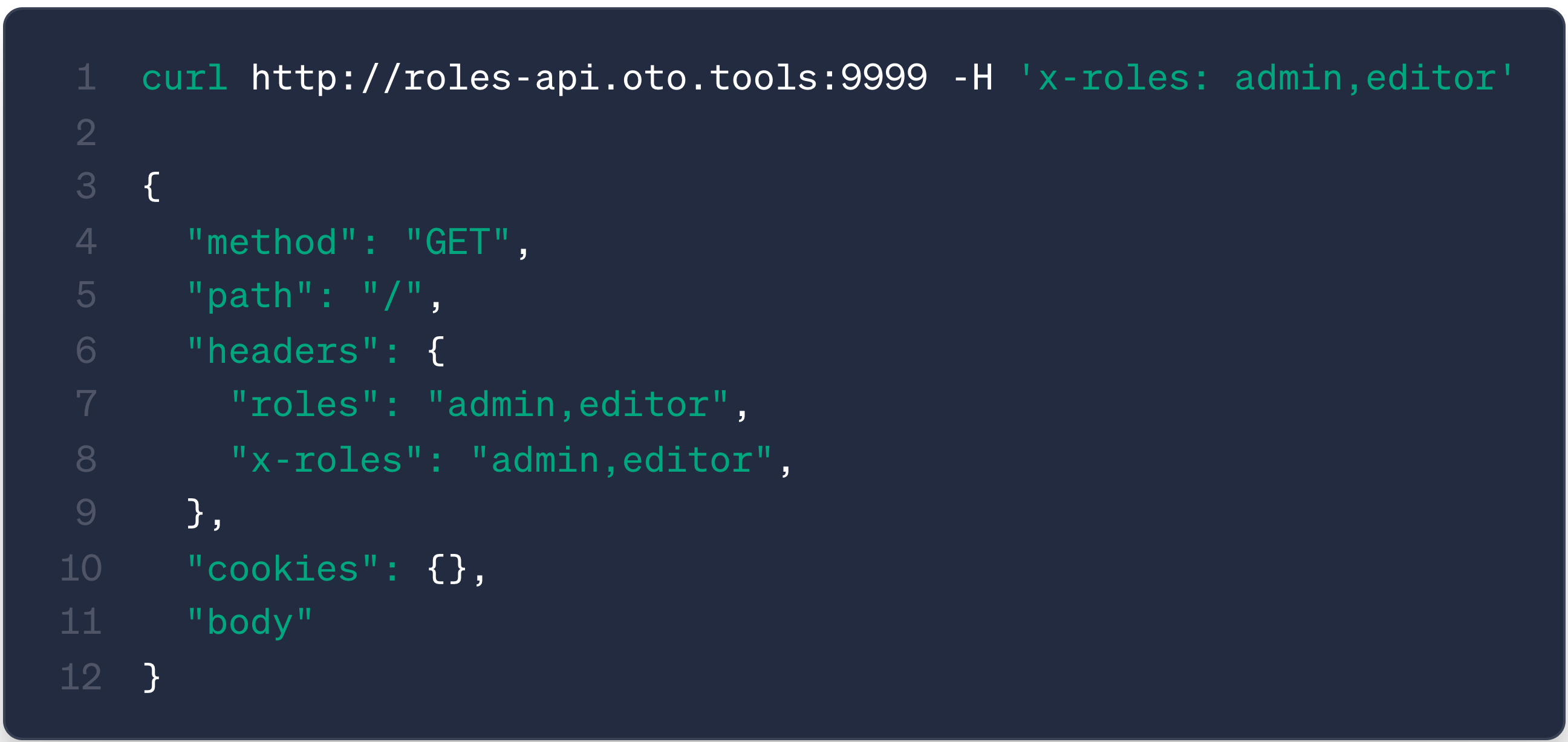
You’ll see the response includes a roles header with the value admin,editor.
Test without any role header:
curl http://roles-api.oto.tools:8080
The Expression Language defaults to anonymous when no role headers are present
You may have noticed there’s one more plugin in the list. Otoroshi doesn’t automatically rewrite the Host header when proxying requests. For backends like request.otoroshi.io (or backends hosted on a special host), the Host header must match the backend’s hostname. This plugin ensures the correct Host is set. On localhost, it isn’t needed because local servers accept any Host.
Step 3: Clean up original headers
By default, Otoroshi forwards all incoming headers to the backend. To ensure your backend only receives the normalized roles header, remove the original headers:
curl -X PUT http://otoroshi-api.oto.tools:8080/api/routes/roles-api \
  -H "Content-type: application/json" \
  -u admin-api-apikey-id:admin-api-apikey-secret \
  -d @- <<'EOF'
{
  "id": "roles-api",
  "name": "roles-api",
  "frontend": {
    "domains": ["roles-api.oto.tools"]
  },
  "backend": {
    "targets": [
      {
        "hostname": "request.otoroshi.io",
        "port": 443,
        "tls": true
      }
    ]
  },
  "plugins": [
    {
      "plugin": "cp:otoroshi.next.plugins.OverrideHost",
      "enabled": true
    },
    {
      "plugin": "cp:otoroshi.next.plugins.RemoveHeadersIn",
      "enabled": true,
      "config": {
        "names": ["x-roles", "user-roles"]
      }
    },
    {
      "plugin": "cp:otoroshi.next.plugins.AdditionalHeadersIn",
      "enabled": true,
      "config": {
        "headers": {
            "roles": "${req.headers.x-roles || req.headers.user-roles || req.headers.roles :: anonymous}"
        }
      }
    }
  ]
}
EOF
Test again to verify the cleanup:
curl http://roles-api.oto.tools:8080 -H 'x-roles: admin'
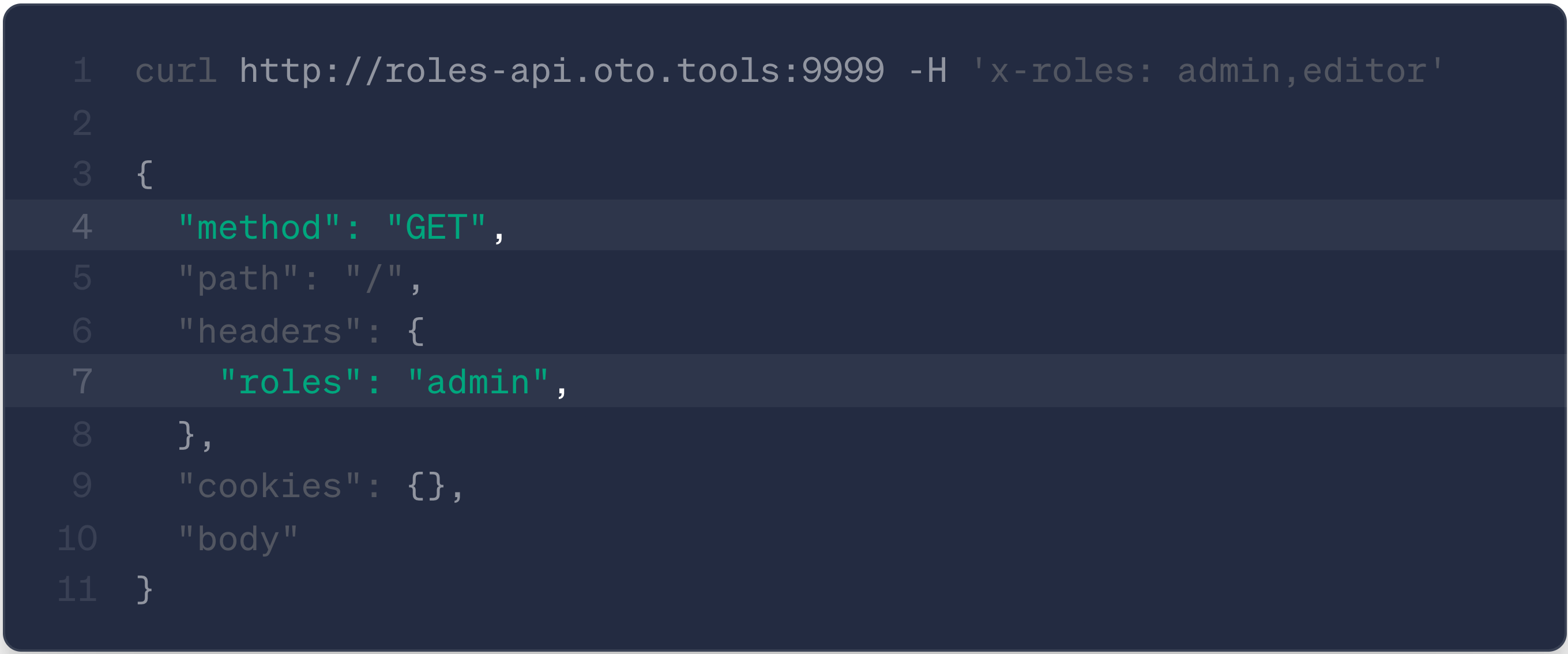
Your backend now receives only the normalized roles header. The original headers (x-roles, user-roles, roles) are removed, ensuring consistent header handling across all teams without modifying any client code.
Summary
What we accomplished:
- Created a route that normalizes multiple role header formats into a single
rolesheader - Used Otoroshi’s Expression Language to provide a default value (
anonymous) when no role headers are present - Cleaned up incoming headers to ensure backends only receive the normalized header
- Eliminated the need for backend code changes or client-side coordination across teams
Plugins used:
roles header using Expression Language